There is a significant difference between declaring war on the terrorists who have made life miserable for the people and committing the huge resources required to sustain that war. In Sokoto State, Governor Ahmed Aliyu’s latest declaration that his administration will continue to wage an unrelenting war against terrorists until they are defeated, life returns to normal and internally displaced persons (IDPs) can return to their ancestral homes is therefore more than a statement of intent. The scale and continuity of the state government’s investment in the fight against insecurity provides the overwhelming evidence of that resolve.
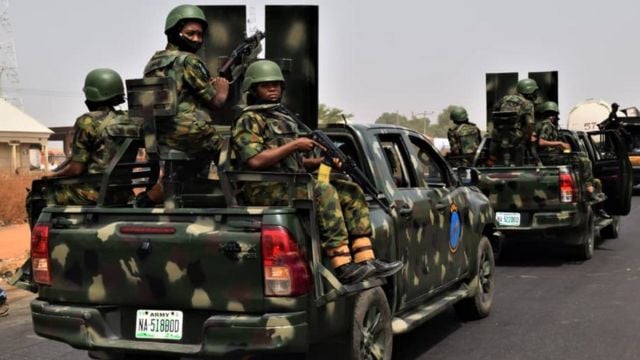
The evidence is in the latest decision of the State Executive Council. The government has awarded a contract for the procurement of 30 Toyota Hilux operational vehicles to further support security agencies in the fight against terrorists and other criminal groups. The vehicles are valued at a whopping ₦1.592 billion. They are in addition to more than 200 Hilux vans and 62 armoured vehicles that it had previously procured and distributed to security agencies. The administration has also constructed a military base at Illela, the border town on Nigeria’s border with Niger Republic.
“We’ll continue to be tough on the bandits until the IDPs return home,” the governor declared while opening the eighth regular meeting of the State Executive Council.
The statement reflects the firm position Governor Aliyu has consistently maintained against negotiating with terrorists, insisting rather on their unconditional surrender. His argument is they have waged war against innocent people, and paying ransom would only embolden them, as experience has shown that such payments often encourage further attacks on the communities.
While Governor Aliyu recognises that tremendous progress has been made in the war against the terrorists, he has wisely refused to become complacent. The latest intervention demonstrates that the government does not consider the security challenge as sufficiently resolved. And the latest procurement is only one component of a much larger security effort.
Since assuming office, the administration has provided more than 200 patrol vehicles to security agencies. It has established the Sokoto State Community Guard Corps, provided it with vehicles and motorcycles to support its operations in the vulnerable communities. They are to help the security forces with intelligence, which is critical in the war.
Security under the Aliyu administration has become a continuing expenditure rather than a one-off intervention, reflecting the government’s unwavering commitment to defeating the terrorists. In July 2026, the government procured and distributed 62 armoured security vehicles and other equipment at a cost of more than ₦27 billion. Barely a month later, the State Executive Council, in reaction to the challenges, approved another ₦1.759 billion for 1,000 motorcycles for the security agencies. Now comes a further ₦1.592 billion for 30 operational vehicles. So, if the issue is expenditure, Governor Aliyu cannot be found wanting. Unfortunately, the insecurity is not limited to Sokoto State. It is a regional crisis that cuts across the North-West states.
This regional character of the crisis has informed efforts by the governors of the North West to strengthen cooperation in the war against the terrorists. The objective is to move beyond isolated, state-by-state responses and improve intelligence sharing, joint planning and the coordination of military operations across state boundaries. Such coordination is important because terrorists do not recognise boundaries; when pressure is increased in one area, they move into another. A more coordinated North-West security response therefore offers a better framework for sustaining pressure on the terrorist groups and preventing them from exploiting gaps between states.
The governors have not limited their efforts to Nigeria. At the just-concluded 81st United Nations General Assembly in New York, the North-West Governors’ Forum presented the Northwest Peace, Security and Development Framework 2026–2030, signalling their commitment to a coordinated approach to the crisis. The framework brings the seven states together around shared security, development and economic priorities, while seeking stronger international partnerships and support for its implementation.
But the administration’s approach goes beyond the purchase of vehicles. It has sought to combine logistics for conventional security agencies with community-based security, intelligence gathering, and stronger operational presence in the vulnerable areas. The establishment of a military base in Illela is part of this broader effort.
The logic is straightforward: Sokoto requires a specific legal framework to complement its operational campaign against banditry. The State Executive Council has approved a bill for the Sokoto State Banditry Special Prohibition Law, 2026, signalling an attempt to strengthen the legal response by specifically penalising and checking the activities of armed bandits. The measure is intended to ensure that the fight against banditry is supported by a legal framework tailored to the particular challenge facing the state.
It is against this background that Governor Aliyu’s declaration must be viewed. It is a reaffirmation of a security policy backed by a substantial war chest and political will. Governor Aliyu is a politician who speaks plainly and has consistently matched his words with action.
Since Governor Aliyu’s famous Katsina declaration in May 2026 — “We will not negotiate with any criminal, nor will we accept any offer from them unless they surrender unconditionally” — nothing has changed in his position. That declaration is significant because it placed the Sokoto State government’s security policy within the broader North-West position.
That position gives greater context to the scale of Sokoto State’s security spending. The argument is essentially that if the government is unwilling to negotiate with the armed groups, it must then be prepared to give security agencies the capacity to confront them.
That is precisely why the investments are relevant. Buying Buffalo vehicles and motorcycles is not a policy in itself; their importance lies in what they enable security agencies to do: reach the vulnerable communities, respond faster, sustain operations and, ultimately, defeat the terrorists. In other words, the equipment provides the operational capacity needed to enforce the government’s security policy.
Governor Aliyu has been particularly vocal about the role of collaborators in sustaining terrorist attacks. For him, the fight against terrorism cannot be limited to the terrorists; it must also extend to the informants who provide them with logistics that enable the terrorists to operate. Such collaborators compromise military operations by revealing the movements and locations of security personnel, warning bandits of impending operations, identifying vulnerable communities and potential targets, and facilitating access to food, fuel, weapons or other supplies. They also help terrorists evade security cordons, thereby undermining carefully planned operations and putting the lives of soldiers and the people at greater risk.
This is why the Governor has argued that security agencies must regard those who aid and abet banditry as serious security threats in their own right. Equally important is that the communities have a responsibility to expose individuals suspected of providing information or logistical support to the terrorists. The logic is straightforward: where an armed group depends on local intelligence and support networks to survive, disrupting those networks is an essential part of defeating the group itself.
Ultimately, Governor Aliyu’s resolve will be judged not by the consistency of his actions. His administration has chosen sustained investment, operational support, intelligence gathering and a refusal to negotiate with terrorists. The objective remains the defeat of the terrorists and the return of the IDPs to their homes. He wants the people of Sokoto State to once again live, farm and travel without fear.
By Emmanuel Ado