For decades, football has marketed itself as the world’s most universal sport—a game where talent, preparation and determination ultimately decide who wins. Yet across Africa, a persistent belief continues to grow that when it comes to international football, the contest is often influenced by forces beyond the ninety minutes on the pitch.
Whether those perceptions are entirely accurate or not, they have become part of African football’s collective experience.
The accusation that FIFA commits “unpardonable crimes” against Africa is emotionally powerful. However, a more balanced analysis requires separating verifiable concerns from broad allegations. While there is no conclusive evidence that FIFA predetermines match results, there have been numerous controversies involving refereeing decisions, disciplinary actions, tournament administration and unequal treatment that have fuelled long-standing suspicions across the continent.
The Roots of African Distrust
Africa’s relationship with global football governance has always been complicated. Despite producing some of football’s greatest talents—from legends to today’s global superstars—the continent has struggled to convert its immense potential into World Cup success.
Many Africans believe this is not simply because of footballing limitations but because the global system has historically favoured traditional powers from Europe and South America.
The perception has been strengthened by repeated controversial officiating decisions during major tournaments.
Several African nations have experienced heartbreaking exits in circumstances that supporters believe involved questionable refereeing interpretations.
These moments have accumulated over decades, creating a narrative that Africa is often judged differently.
Whether justified or not, perceptions matter. In sport, repeated controversial decisions involving the same region inevitably breed distrust.
The Refereeing Question
Perhaps no issue generates more debate than refereeing.
African fans frequently argue that identical challenges are interpreted differently depending on the teams involved. A physical challenge made by an African defender may attract an immediate foul or booking, while similar tackles on African players often receive less protection.
Football’s Laws of the Game are intended to be applied uniformly, regardless of nationality. Yet the sport still relies heavily on human interpretation.
What one referee considers “aggressive but fair,” another may classify as reckless.
This subjectivity becomes particularly contentious when African teams feel disadvantaged in high-profile matches.
The introduction of Video Assistant Referee (VAR) was expected to eliminate many of these controversies. Instead, debates have simply shifted from referees’ whistles to VAR interpretations.
Supporters ask why similar incidents produce different outcomes in different matches. These inconsistencies continue to undermine confidence in football’s commitment to equal treatment.
Psychological Pressure Before Kick-Off
Another recurring complaint involves what many African football followers describe as psychological intimidation.
Top European and South American nations often arrive at major tournaments carrying enormous reputations.
Referees, consciously or unconsciously, may be influenced by those reputations.
Sports psychology recognises that unconscious bias exists in every profession.
When established football powers face emerging nations, expectations can subtly affect decision-making.
African teams argue they frequently enter matches already battling historical perceptions.
Instead of beginning at 50-50, they believe they must first overcome assumptions about discipline, physicality and tactical sophistication.
While impossible to quantify, the influence of reputation has been acknowledged in numerous sporting studies.
Unequal Standards
One of the strongest criticisms concerns consistency.
Football supporters expect identical offences to attract identical punishments.
Instead, critics argue that disciplinary standards sometimes appear inconsistent.
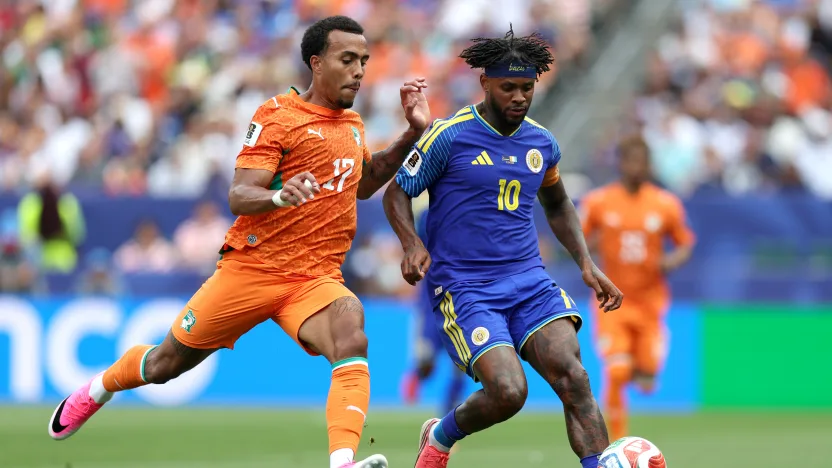
An incident involving an African player may result in suspension or sanction, while comparable actions involving players from traditional football powers sometimes appear to receive more lenient treatment.
For instance, the Round of 16 game between Argentina and Egypt played on Tuesday threw more lights on the argument. While Egypt’s Captain and playmaker, Mohammed Salah was hacked twice by Argentine defender, the referees including the VAR ignored the act, but a minor tackle happened to an Argentine during a build up to Egypt’s second goal. Without hesitation, both the Centre Referee and VAR became active. The result: Egypt’s second goal was disallowed.
Another instance, in the opening game involving Argentina and Tunisia, Messi was caught even by the cameras in an ungentlemanly and brutal tackle against a Tunisian, but it was waved aside without even a verbal warning. Should it have been the other way round, the Tunisian would have had a Red Card for the act.
Whether these are isolated incidents or evidence of systemic problems remains open to debate. Nevertheless, football governance depends not only on fairness but on the appearance of fairness. Once supporters lose confidence in consistent application of rules, every controversial decision becomes evidence supporting existing suspicions.
Representation Matters
Another issue lies beyond the football pitch. Although Africa accounts for a significant proportion of FIFA’s member associations and supplies elite players to clubs worldwide, questions remain about the continent’s influence within football’s highest decision-making structures.
Governance shapes policy.
Appointments shape perspectives.
Representation shapes priorities.
If decision-making bodies lack sufficient diversity, perceptions of imbalance inevitably grow.
Greater African participation in technical committees, refereeing departments and disciplinary panels would strengthen confidence that different football cultures are adequately represented.
Infrastructure Inequality
Africa’s challenges are not solely the responsibility of FIFA.
Many African football associations continue to struggle with governance issues, inadequate infrastructure, political interference and financial mismanagement.
These internal problems weaken the continent’s competitiveness. However, critics argue FIFA’s development programmes have not sufficiently addressed structural inequalities between established football powers and developing football nations.
European federations benefit from stronger domestic leagues, better facilities, advanced coaching systems and greater commercial investment.
Closing that gap requires more than development grants. It demands sustained institutional commitment.
Media Narratives
International media coverage also contributes to perceptions of inequality.
European and South American teams are frequently portrayed as tactical, intelligent and technically gifted.
African teams are often stereotyped as merely athletic or physically strong.
These narratives influence global perceptions and, critics argue, may indirectly affect officiating.
Football should judge players by performance rather than outdated stereotypes.
That takes us back to the aforementioned tackles in both games involving Argentina. If a Lionel Messi or McAllister were players of Tunisia or Egypt and vice versa, those tackles by them would have been taken serious because “as African players, they’re physical”.
Modern African football has evolved significantly, producing tactically sophisticated teams capable of competing with the world’s best.
Yet outdated assumptions sometimes persist.
The Need for Evidence
While frustrations are understandable, allegations that FIFA deliberately decides matches before kick-off require strong evidence.
No publicly available proof demonstrates systematic manipulation of match outcomes against African teams.
Many controversial results can also be explained by football’s inherent unpredictability, human error or individual refereeing mistakes.
For criticism to drive reform, it must remain grounded in verifiable facts.
Documented inconsistencies in officiating, governance transparency and disciplinary procedures provide stronger foundations for advocacy than claims that cannot be substantiated.
A Path Toward Greater Trust
If FIFA wishes to rebuild confidence among African football supporters, transparency must become a priority.
Refereeing assessments should be more open.
VAR communications should be publicly accessible.
Disciplinary decisions should clearly explain the reasoning behind sanctions.
Greater consistency would reduce speculation.
Similarly, investment in African football should extend beyond infrastructure to include referee development, coaching education and stronger institutional partnerships.
African football also has responsibilities.
National federations must improve governance, eliminate corruption and invest in youth development.
Competitive excellence begins at home.
Strong domestic systems produce stronger national teams.
Conclusion
The debate over FIFA’s treatment of Africa reflects more than disputed refereeing decisions. It speaks to a deeper desire for equality, respect and recognition within world football.
Africa has produced extraordinary players, the likes of George Opone Weah, Austine “Jay Jay” Okocha, Abedi Pele Ayew, Nwankwo Kanu, Roger Milla, Mbou, Timouni, passionate supporters such as the Raufu Ladipo-led Nigeria Supporters Club to the various FIFA World Cup competitions, particularly the USA ’94 and unforgettable football moments. What many across the continent continue to demand is not preferential treatment but equal treatment.
Whether every allegation against FIFA can be proven is less important than recognising that perceptions of unfairness have persisted for generations. Those perceptions will not disappear through public relations campaigns alone.
They will fade only when football consistently demonstrates that every nation—regardless of history, geography or commercial influence—competes under the same standards, governed by the same rules and protected by the same commitment to fairness. Unfortunately, what African nations are accusing FIFA of is equally embedded in the continent’s football governing body; Confederation of Africa Football (CAF) and this was recklessly exhibited in the last Afcon hosted by Morocco.
Until then, debates over unequal treatment will remain part of the global football conversation, reminding the game’s governing institutions that credibility is earned not merely by writing the rules, but by applying them equally to everyone.
By BEN NWACHUKWU