The sealing of an office occupied by the opposition African Democratic Congress (ADC) in Sokoto by the state government has introduced another dimension to the unfolding political contest in Sokoto State. What initially appeared to be a disagreement over the ownership of a building has rapidly evolved into a wider controversy involving the exercise of executive authority, with the opposition-party shrilly alleging political intimidation.
The ADC had been preparing to host its presidential campaign flag-off in Sokoto, an event expected to attract its national leadership, presidential candidate Atiku Abubakar, former Sokoto governor and party leader Aminu Waziri Tambuwal, as well as party faithful from different parts of the country.
The event, initially scheduled for October 31, was postponed to November 4 following a controversy involving accommodation arrangements for delegates and allegations of attacks on party supporters. The subsequent sealing of the party’s campaign office has further complicated an already tense political environment.
The Sokoto State government clearly explained that its intervention was necessitated by a property-ownership dispute compounded by a recent disturbance involving party supporters and suspected miscreants.
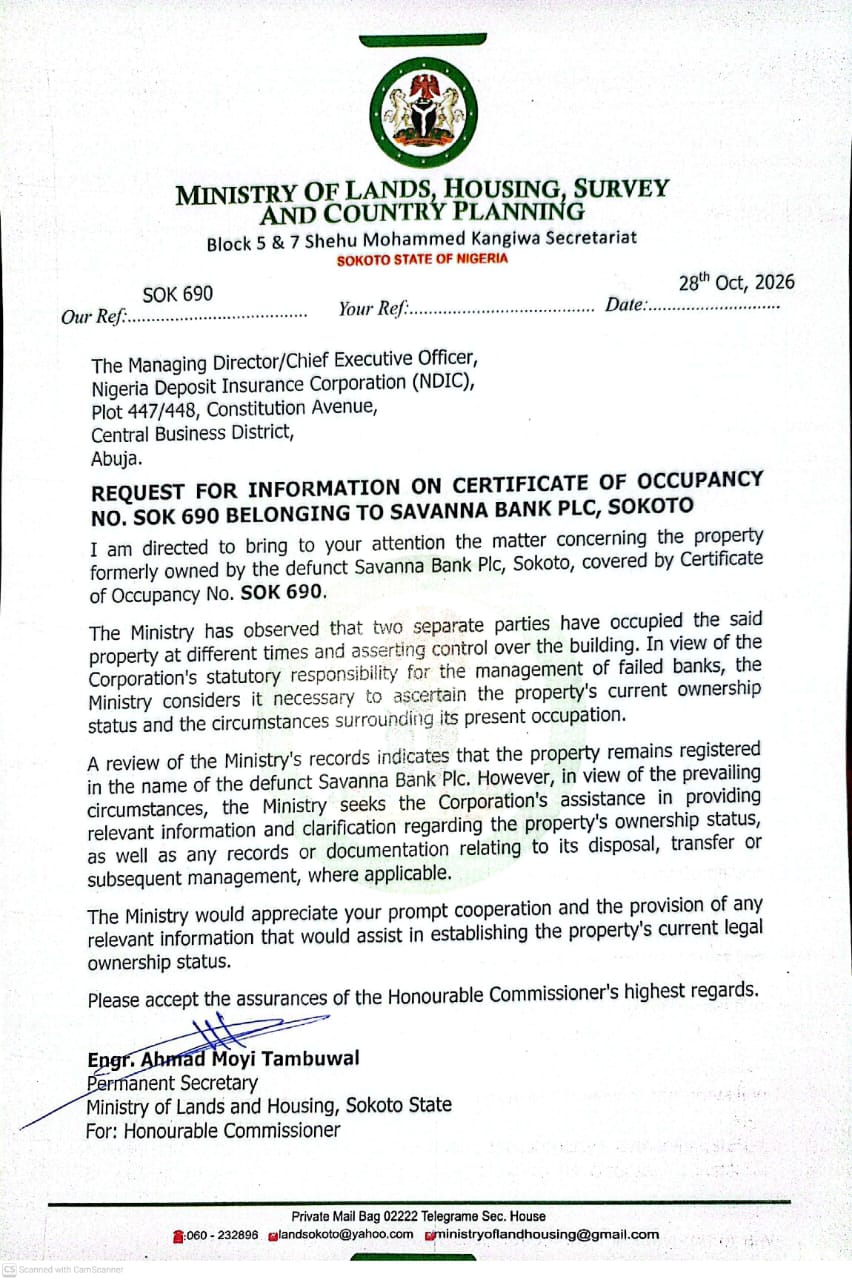
On Monday, November 2, the Commissioner for Lands and Housing, Barrister Nasiru Dantsoho, announced that the government had sealed the premises occupied by the ADC after reviewing the property’s Certificate of Occupancy and other relevant documents.
According to him, the documents indicated that the property originally belonged to the defunct Savannah Bank, with no official record showing that ownership had subsequently been transferred to another individual or organisation.
The commissioner disclosed that the government had written to the Nigeria Deposit Insurance Corporation (NDIC), which he identified as the custodian of the property, seeking clarification on its present ownership.
Pending that clarification, the government decided to seal the premises, explaining the measure was intended to prevent further confrontation, protect lives and property, and preserve public order. Dantsoho also warned the premises would remain under government control until the ownership question was resolved, cautioning against any unauthorised attempt to gain access.
Property ownership is not a trivial administrative matter. Government has a responsibility to protect disputed public assets, prevent unlawful occupation and ensure that land administration follows due process. If the property genuinely remains vested in Savannah Bank’s liquidation estate or under NDIC’s custody, there is a legitimate question about the legal basis upon which the ADC occupies it.
The government has reasonably demonstrated that its concerns are legitimate and its intervention was legally authorised, proportionate and procedurally fair.
Another major flashpoint was the opposition party’s allegation that hotels in Sokoto metropolis had been pressured to deny accommodation to delegates expected for its November 4 presidential campaign flag-off. The party’s campaign spokesperson, Dahiru Maishanu, alleged that hotel operators had been instructed to turn away ADC visitors, with some delegates reportedly encountering difficulties even after making accommodation arrangements.
But the state government would have none of that. Through Commissioner for Information Sambo Danchadi, it rejected the allegation, insisting it had not issued any directive preventing hotels from accommodating ADC members.
An alternative explanation was offered by an APC chieftain, Malami Bajare, who linked the reported accommodation difficulties to increased demand associated with activities marking the Sultanate Council’s 20th anniversary. He maintained that the pressure on hotel rooms should not be interpreted as a political restriction.
The important task for law enforcement is to establish what actually happened, identify those responsible for any violence and ensure that political affiliation neither confers immunity nor creates presumptions of guilt.
Governor Ahmed Aliyu assumed office in May 2023 under the APC platform, inheriting a state with complex security, economic and governance challenges. His administration has since pursued its own development and security priorities while navigating an increasingly competitive political environment.
The ADC’s emergence as a rallying platform for prominent opposition figures, including Atiku Abubakar and Tambuwal, has inevitably raised the political temperature in Sokoto. Tambuwal’s role is particularly significant. Having governed Sokoto for eight years before handing over to Aliyu in 2023, he remains a significant political figure whose relationship with the current administration has acquired an additional dimension through the ADC.
The contest is therefore not simply between two political parties. It also reflects the changing configuration of political loyalties, elite influence and competing ambitions in a state whose politics has historically been shaped by powerful personalities, party structures and the Sultanate’s wider social influence.
The ADC’s confrontation with the Aliyu administration is consequently a struggle over political visibility. But it must equally understand that political competition does not confer immunity from property laws, public-order regulations or the responsibility to conduct its activities peacefully. Opposition parties must not exploit legitimate administrative disputes to evade lawful obligations.
Section 40 of the 1999 Constitution guarantees every person the right to assemble freely and associate with others, including the right to form or belong to a political party. There are, of course, constitutional qualifications. Section 45 permits restrictions on certain fundamental rights where they are reasonably justifiable in a democratic society in the interests of public safety, public order, public morality or public health, among other considerations. And this is what the Sokoto State Government is enforcing.
Put simply, the government has legitimate powers to prevent violence, regulate public safety and protect property. And it is exercising these powers lawfully, proportionately and without discrimination so far. Clearly, a political party cannot invoke freedom of association to justify occupying property without lawful authority.
In the present circumstances, the crucial questions are whether the Sokoto Government has the legal authority to seal the disputed premises. It has. If the ADC believes its rights have been violated, the courts provide a constitutional avenue for redress.
The controversy has now attracted the attention of Amnesty International, which has condemned the sealing of the ADC office. In a statement reported on November 3, the organisation described the government’s action as an attempt to suppress opposition and undermine democratic freedoms. Amnesty’s intervention does not, by itself, establish the legal ownership of the building or prove that the state government orchestrated political violence.
A balanced examination must interrogate the conduct and political calculations of the ADC. The party is entitled to organise, mobilise supporters, hold rallies and challenge the governing APC. It is equally entitled to question the administration’s performance on insecurity, economic hardship, public services and other governance issues.
But political opposition is not simply about accusing the ruling party of intolerance. It must also demonstrate organisational discipline, responsible leadership and respect for the law.
The police statement that political parties had been advised to notify security agencies of planned movements also deserves attention. Such coordination can be a reasonable security precaution, particularly in a state confronting serious security challenges. The ADC must provide credible evidence for its allegations of interference. This is how democratic accountability works. Claims or allegations must be tested, not merely amplified.
There is another dimension to this unfolding confrontation that cannot be ignored. This is the historical and political character of Sokoto itself. Sokoto is not merely another state in Nigeria’s federation. It is the historic centre of the Sokoto Caliphate, a society whose political, religious and intellectual traditions have exerted considerable influence across Northern Nigeria.
Its political environment is consequently shaped by a complex interaction of traditional authority, religious leadership, political elites, community networks and party structures. The Sultanate remains an important moral and traditional institution, while elected governments derive their authority from constitutional and electoral processes.
Governor Aliyu’s administration operates within a political environment in which governance performance, political relationships, public expectations and traditional institutions all influence the wider climate.
With former Sokoto State governor Aminu Tambuwal now associated with the opposition platform and Atiku Abubakar positioned as its presidential standard-bearer, the party has acquired a political dimension that makes its activities in Sokoto particularly significant.
For the ADC, Sokoto offers more than a geographical location for a campaign rally. It represents an opportunity to demonstrate political relevance in a strategically important North-Western state and consolidate an opposition constituency around established political personalities.
For the ruling APC, the growing visibility of the opposition presents the challenge of defending its political record and retaining its organisational influence. These are legitimate political contests.
The timing of this controversy is also noteworthy because Sokoto is simultaneously celebrating the twentieth anniversary of Sultan Muhammad Sa’ad Abubakar III’s ascension to the throne. The Sultan’s two decades on the throne have been associated with advocacy for peaceful coexistence, religious tolerance, national unity and dialogue across political and social divides.
President Bola Tinubu, Governor Aliyu and other national figures have publicly acknowledged his contributions to peacebuilding and national cohesion. The Sultan’s anniversary therefore provides an appropriate moment for reflection on the larger values that should govern public life in Sokoto.
In a society with Sokoto’s history, political disagreement should not become a pretext for social hostility. The democratic challenge is to ensure that the competition for political power does not undermine the shared civic space that binds the people together.
The ADC should exercise political restraint, substantiate its allegations and ensure that its supporters comply with legitimate security and property regulations. An opposition party’s ambition to displace an incumbent administration does not confer a licence to disregard established laws.
Afterall, the maturity of an opposition is measured not simply by its capacity to criticise those in power, but by its willingness to operate within the same constitutional framework it demands government should respect.
Governor Aliyu’s administration has demonstrated a resolve to deal with the present dispute transparently, establish the legal facts surrounding the property and demonstrate that its commitment to public order is consistent with the protection of political freedoms. The ADC, for its part, must show that its opposition politics can be conducted with discipline, credible evidence and respect for the law.
While in the final analysis, a governor may preside over a state but does not own its democracy, an opposition party may challenge a government, but it must never stand above the law. That is the constitutional balance Sokoto must defend as Nigeria approaches another crucial electoral season
By Louis Achi