What does organised player representation look like when it becomes part of the structure of professional football rather than something players have to fight to be recognised?
France offers an important example.
The lesson is not that French football has solved every labour problem. It has not.
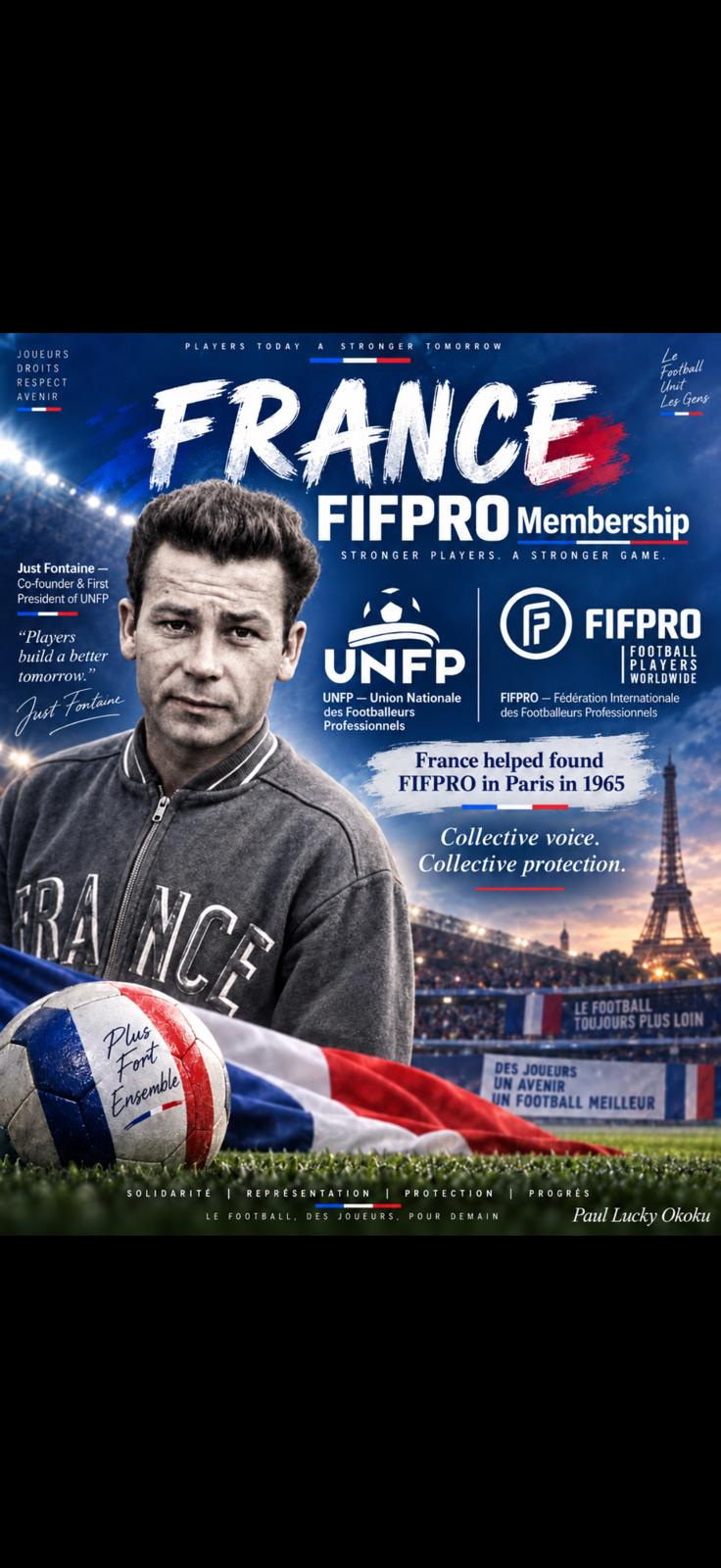
The lesson is that professional footballers have an established organisation — the Union Nationale des Footballeurs Professionnels, UNFP — capable of sitting across the table from employers and negotiating conditions affecting players collectively.
That distinction matters.
A footballer should not have to negotiate every workplace protection alone.
COLLECTIVE BARGAINING PRODUCES CONCRETE RESULTS
In July 2026, UNFP and French football’s employer representatives signed new collective agreements covering professional women’s football and the newly structured men’s Ligue 3.
These were not ceremonial documents.
They established enforceable employment standards.
For players in Ligue 3, the agreement requires clubs to maintain at least 16 full-time professional players. Minimum salaries range from €2,000 to €2,800 depending on a player’s development pathway. Players joining clubs are entitled to seven nights of accommodation, while sickness provisions guarantee at least 90 days of continued salary.
The agreement also preserves certain pension rights and establishes collective protection of players’ image rights.
These are examples of what collective representation can mean in practical terms.
Salary.
Housing.
Healthcare.
Employment security.
Pension protection.
Image rights.
LIGUE 1 AND LIGUE 2 DID NOT ARRIVE HERE BY ACCIDENT
France did not suddenly discover collective bargaining in 2026.
Long before the new agreements covering Ligue 3 and the women’s professional game, players in France’s top professional divisions had already fought to establish a stronger collective voice.
The Charte du football professionnel, whose origins date to 1973 following the first strike by French professional footballers, became an important framework governing relations among clubs, football authorities, players and other employees in the professional game.
Today, players in Ligue 1 and Ligue 2 operate within that established collective structure.
That history matters.
The protections French players have today were not simply handed to them.
They were built through organisation, disagreement, negotiation, collective action and persistence.
Understanding what French players went through to reach this point is therefore just as important as describing the protections they now enjoy.
It reminds us that strong player representation is usually not a gift from the football establishment.
It is something players organise to achieve — and then continue working to protect.
WOMEN NOW HAVE A COLLECTIVE FRAMEWORK TOO
The agreement covering France’s top two women’s divisions is particularly significant because it creates a dedicated collective employment framework.
Among its provisions are minimum numbers of contracted players, full-time employment standards in the Première Ligue, minimum part-time hours in the Seconde Ligue, six weeks of paid annual leave and continued salary during qualifying sickness absence.
Pregnancy and maternity are addressed specifically.
Players receive 16 weeks of guaranteed maternity pay without a qualifying period, continued salary during pregnancy-related absence, paid breastfeeding breaks and continued access to club medical and athletic facilities during pregnancy.
These are not football privileges.
They are workplace protections adapted to football.
EUROPE HAS BUILT A TABLE FOR NEGOTIATION
France operates within a wider European labour environment.
At continental level, FIFPRO Europe represents players in the European Sectoral Social Dialogue for Professional Football, where recognised representatives of employees and employers discuss working conditions.
In March 2026, FIFPRO Europe and representatives of the European Commission again emphasised collective bargaining, occupational health and safety, contractual protections and legitimate worker representation as central parts of professional football employment.
FIFPRO Europe represents dozens of national player unions; 33 unions attended its 2026 General Assembly in Prague.
That does not mean every European footballer enjoys identical conditions.
Far from it.
Payment disputes, weak employment protection and inadequate social security still exist in parts of European football.
But there is an important institutional principle:
players belong at the table where their working conditions are decided.
EVEN FRANCE STILL HAS BATTLES TO FIGHT
Organised representation does not eliminate disagreement.
UNFP has also challenged concerns about excessive workload and player health through the European Social Charter system.
In March 2026, the European Committee of Social Rights declared admissible a UNFP complaint raising issues including health and safety, collective bargaining, protection of young players and the effect of an expanding international calendar on working conditions. The merits of those claims remain subject to the relevant process.
That itself illustrates another benefit of organised representation.
When an individual footballer confronts an institution, the imbalance can be enormous.
When players organise collectively, they can negotiate, challenge, research, litigate and advocate through an institution built to represent them.
THE LESSON FROM FRANCE
France should not be copied blindly.
Every football country has its own legal system, economy and football structure.
But the principle travels well.
Professional football produces rules about contracts, wages, medical care, workload, discipline, transfers, pensions and image rights.
Those rules affect footballers’ livelihoods.
The people whose careers are governed by those rules should therefore have meaningful representation when those rules are written.
That is what mature player representation begins to look like.
Not merely having an association.
Not merely having officials.
But having a recognised seat at the negotiating table — and using that seat to turn player voice into actual employment protection.
By Paul Lucky Okoku
FIFA Legend | Former Nigeria Flying Eagles Vice-Captain | Former Super Eagles International | AFCON Silver Medalist | Football Historian | Football Analyst | Investigative Football Writer | Journalist-at-Large | Founder & CEO, Greater Tomorrow Children’s Fund (GTCF)