
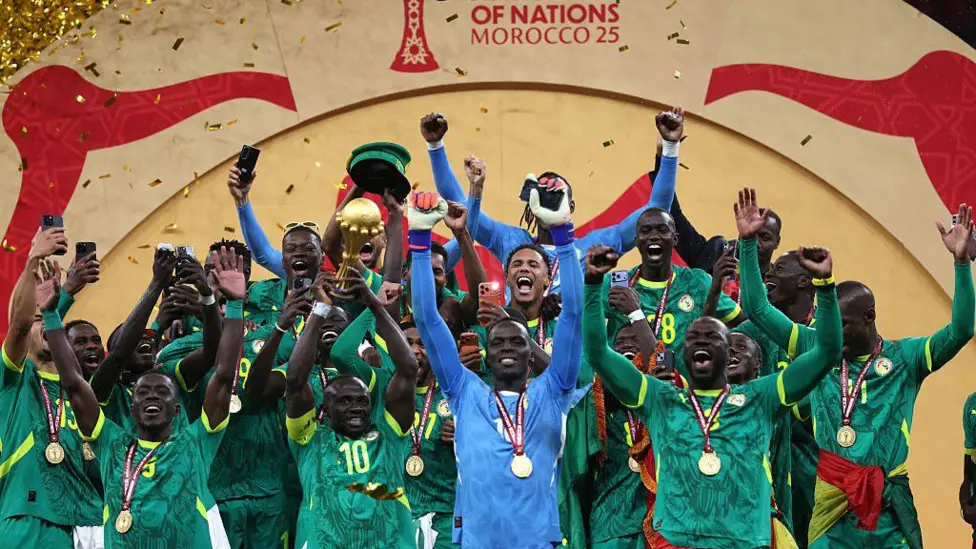
They ( Senegal) won the 2025 Africa Cup of Nations final on the pitch 1–0 after extra time against hosts Morocco in Rabat. The referee blew the final whistle. The trophy was lifted. The medals were handed out. History, it seemed, had been written.
And then it was erased.
In a decision that has sent shockwaves through global football, the Confederation of African Football Appeal Board has overturned that result, ruling that Senegal forfeited the final and awarding a 3–0 victory—and the title—to Morocco.
This is not just a controversial decision. It is a defining moment for the governance of the sport.
Because it forces an uncomfortable question: if the final whistle no longer guarantees finality, what exactly does it mean to win a football match?
The facts of the case are as dramatic as the ruling itself. The final was marred by chaos—most notably when Senegal’s players walked off the pitch in protest after a disputed penalty decision late in the game.
They eventually returned, completed the match, and won it. That should have been the end of the matter—at least in footballing terms.
But it wasn’t.
CAF, invoking its regulations (specifically Articles 82 and 84), determined that Senegal’s conduct constituted a breach serious enough to invalidate the result and impose a forfeit.
Legally, the framework exists. Competitions have long reserved the right to sanction teams for misconduct, including awarding forfeits. In that narrow sense, CAF is on defensible ground.
But legality is not the same as legitimacy.
Football rests on a fragile but essential principle: what happens on the pitch must carry primacy.
The referee—operating under the FIFA Laws of the Game—is the sole authority over match facts. Goals scored, matches completed, outcomes decided. These are meant to be sacrosanct, insulated from retrospective reinterpretation.
CAF’s ruling does not technically rewrite those facts. Senegal did win the match as played. Instead, it reclassifies the outcome administratively—transforming a victory into a forfeit defeat.
That distinction may satisfy legal purists. It will not satisfy the broader football public.
Because to fans, players, and history itself, the difference is academic. The scoreboard said 1–0. The champions celebrated. Now, the record books say 3–0—to the other team.
That is not regulation. That is revision.
To be clear, Senegal’s conduct was not beyond reproach. Walking off the pitch in protest undermines the authority of match officials and disrupts the integrity of competition. Even FIFA president Gianni Infantino condemned the scenes as “unacceptable,” emphasizing that teams must respect officials and remain on the field.
Sanctions were inevitable—and justified.
Fines, suspensions, even stadium bans—these are proportionate responses. They punish misconduct without distorting the sporting contest.
But stripping a title after the match has been played to completion crosses into far more dangerous territory. Because it introduces a precedent that extends beyond this single final.
If a completed match can be overturned due to in-game misconduct—even after it resumes and concludes—then where is the threshold?
How long after the final whistle does a result remain vulnerable? What constitutes a sufficiently serious breach to justify rewriting an outcome?
And perhaps most importantly: who decides?
The risk is not merely inconsistency. It is erosion of trust.
Football derives its power from immediacy. Ninety minutes decide everything. That is the sport’s social contract with its audience. Break that contract, and the game becomes something else—less visceral, less certain, less real.
CAF may argue that it is protecting the integrity of the competition. But integrity is not only about enforcing rules. It is also about preserving the credibility of outcomes.
And here lies the paradox: in seeking to punish disorder, CAF may have created a deeper form of disorder—one that exists not on the pitch, but in the very logic of the sport.
Senegal’s victory in Rabat will now live in a strange limbo—won on the field, lost in the courtroom.
Morocco are champions, officially and rightfully so under CAF’s ruling. But theirs is a title that will always carry an asterisk, not because they did anything wrong, but because of how it was awarded.
And football, for all its complexities, has always tried to avoid asterisks.
The final whistle is supposed to mean something.
After this decision, it means less.
And that may be the most significant loss of all.
Remi Kisu(TheCable)