There are few African footballers who are exemplary and worthy of emulation like Sadio Mane, Mohammed Sala, Didier Drogba, Samuel Eto and George Weah, who later became President of Liberia, riding on his seeds sown as a player.
These players all come from poor backgrounds or if you like very modest backgrounds but by dint of hardwork, determination, dreams and humility rose to the pinnacle of their careers.
It is not a surprise that all these players at one time or the other were crowned African Footballer of the Year. George Weah was the first and only man to have won the Ballon D’Or, European Footballer Of the Year and the African Footballer of the Year in 1995.
A rare feat for an African player competing against the best in the world yet been able to soar above his peers.
Mo Sala was voted twice in 2017 and 2018 as African Footballer of the Year, same years he also won the BBC African Footballer of the Year back-to-back given his stellar performances with Liverpool.
He was the first Egyptian to win AFOTY since 1983 and the first North African to win it back-to-back.
Drogba on his part won the award in 2006 and 2009 and the first Ivorian to do so, in addition was also BBC African Footballer of the Year in 2009. The glorious years of Drogba was his time with Chelsea where he was a household name, even up till date.
In the history of CAF AFOTY, double D, as Drogba is popularly called by his fans remains the most top three finisher with nine.
Samuel Eto, current President of FECAFOOT was the first African to win the AFOTY four times in 2003 while playing with Real mallorca, 2004 with Barcelona, 2005 with Barcelona and 2010 while playing for Inter Milan.
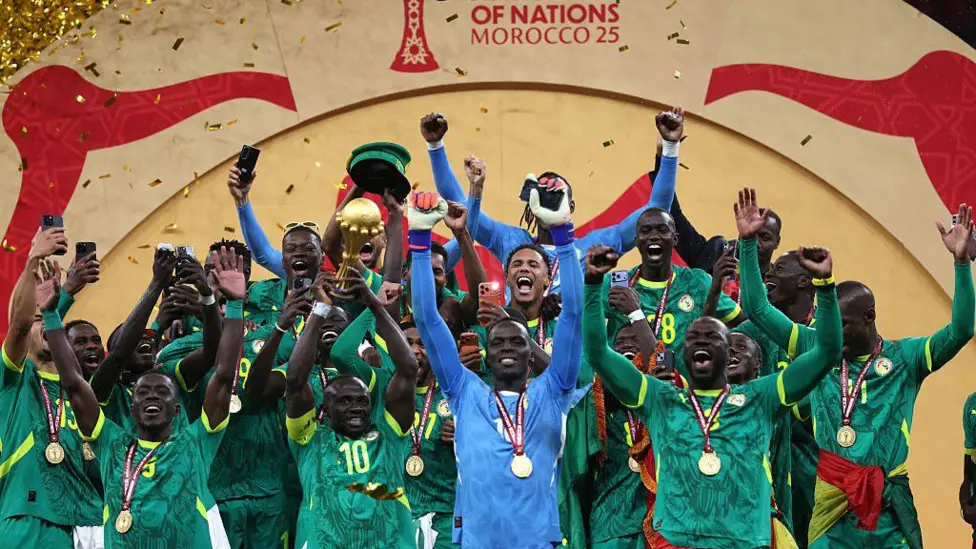
Mane, the second highest ranked African in the Ballon D’Or, behind George Weah, second in 2022, was voted AFOTY in 2019 and 2022, and at the just concluded AFCON in Morocco was voted as the Player of the Tournament.
Having highlighted how these players have attained the zenith of their careers with club and country,though Weah was not able to make it to the World Cup with Liberia, he was the brain behind Liberi’sa desperate efforts to play at the mundial.
Beyond their contributions to their countries in the field of play, they had also shown an uncommon patriotism in giving back to their communities off the field of play.
Drogba played a big role in 2005-2007 in ending the five year civil war in Ivory Coast by using his influence to unite a fractured nation.” Followiing a world cup qualification, he made a television plea on his knees for peace.He further moved a 2007 qualifying match against Madagascar to the rebel stronghold in Bouake, fostering reconciliation”
This singular act to move a match to a rebel stroghold, was seen as a major gesture of unity,which effectively bridged the divide between the North and South and helped to initiate peace negotiations and ultimate ceasefire.
Sala lately built a free medical centre for elderly people in Egypt who have no one to take care of them with everything free from disgnosis, treatment, surgery, and medication as his own way of giving back to his people.
But Sadio Mane has been more than exemplary in this direction in uplifting and changing the face of his little village of Bambali.
From when he ran away from home to France with only his dream to better his lot, Mane has made himself a cult-hero in his village and Senegal.
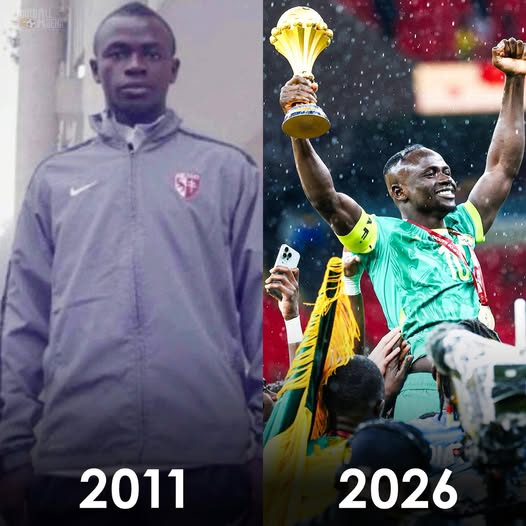
In 2011, Mane arrived in France and finally got a placement at Metz and took a picture to tell his mother he was safe and sound but pursuing a dream to change their family status. A look at the picture taken in 2011 and that at AFCON 2025 tells the story of nothing but grass to grace on the back of humility, hardwork and love for his people.
At just 19 years old, freshly in France from Senegal, he wanted to send a picture to his mother wearing his new club’s shirt. He didn’t own a camera, so he asked a reporter to take it for him.
And when the reporter asked for his email, he may not even know what an email was because he had none but smartly gave gave the club’s email.
Not unexpected given his background and innocence, he asked: “The photo is free, right?”
“All of this traces back to when he was only 15—when he ran away from his village, Bambali, chasing a dream no one else believed in.
He walked for miles, borrowed money to catch a bus to Dakar, and arrived with nothing in his pockets but hope.”
The story today is different because that innocent poor boy who ran away ffrom home to pursue a dream is now : two time African Footballer of the Year, Two Time AFCON winner and also now a global football icon
And above all, a man who never forgot where he came from
Mané built hospitals, schools, provided free internet and electricity, supported families with monthly income, and completely transformed Bambali—changing thousands of lives along the way.
“Mané proves that dreaming big and staying grounded can move more than trophies… it can move entire communities.”
Mane and his likes highlighted above a truly worthy examples to emulate.