Haile Gebrselassie didn’t just run races — he chased history, caught it, waved politely, and then kept running.
Born in rural Ethiopia, young Haile grew up running miles to school every day, often barefoot, carrying books under one arm. What looked like childhood necessity turned out to be destiny doing warm-up drills. While most kids were learning multiplication tables, Haile was unknowingly training for global domination — one dusty road at a time.
By the 1990s, the world learned his name the hard way: by trying and failing to keep up. On the track, Haile wasn’t just fast — he was relentless. When the pain kicked in and others slowed, he smiled. Literally smiled. (Nothing is more intimidating than a man grinning while you’re questioning all your life choices.)
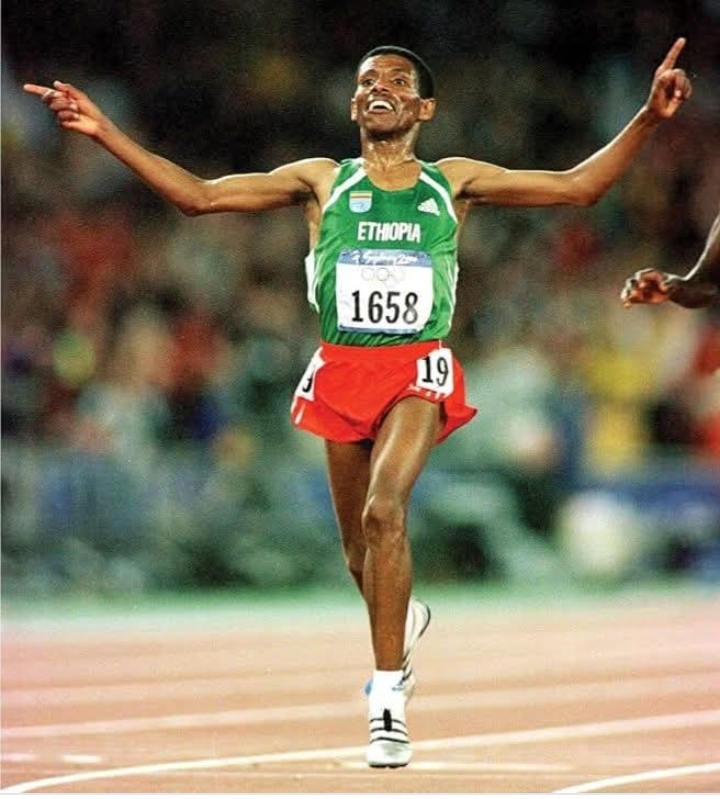
At the 1996 Atlanta Olympics, he stormed to gold in the 10,000 metres. Four years later in Sydney, he did it again — same distance, same medal, same message: I’m not done yet. Meanwhile, at the World Championships, he treated the 10,000 metres like his personal property, winning it four times in a row. If consistency were a race, Haile would’ve lapped it.
Then came the records. And more records. And… yes, even more records.
Twenty-seven world records, from middle distance to the marathon — because apparently specializing is optional when you’re Haile Gebrselassie.
But the real drama unfolded on the roads.
When Haile moved to the marathon, skeptics whispered, “He’s too old.” Haile responded by winning the Berlin Marathon four times in a row, casually rewriting history while doing it. In 2008, he crossed the finish line in 2:03:59, becoming the first human being ever to run a marathon under 2 hours and 4 minutes. The shoes were new, the crowd was roaring, and physics briefly considered resigning.
Oh — and in case Berlin wasn’t enough, he also won the Dubai Marathon three straight times, just to remind everyone that desert heat was also not his problem.
Through it all, Haile remained joyful, humble, and disarmingly funny. He joked about pain, laughed after victories, and ran with a lightness that made suffering look optional. By the time he retired in 2015, he hadn’t just collected medals — he had inspired an entire generation of runners to believe that limits are mostly imaginary.
Haile Gebrselassie didn’t just prove how fast a human could run.
He proved how far joy, discipline, and stubborn belief could carry you.
And somewhere out there, a dusty road is still wondering how it helped create a legend.
Winnie Chepkorir, FB Page