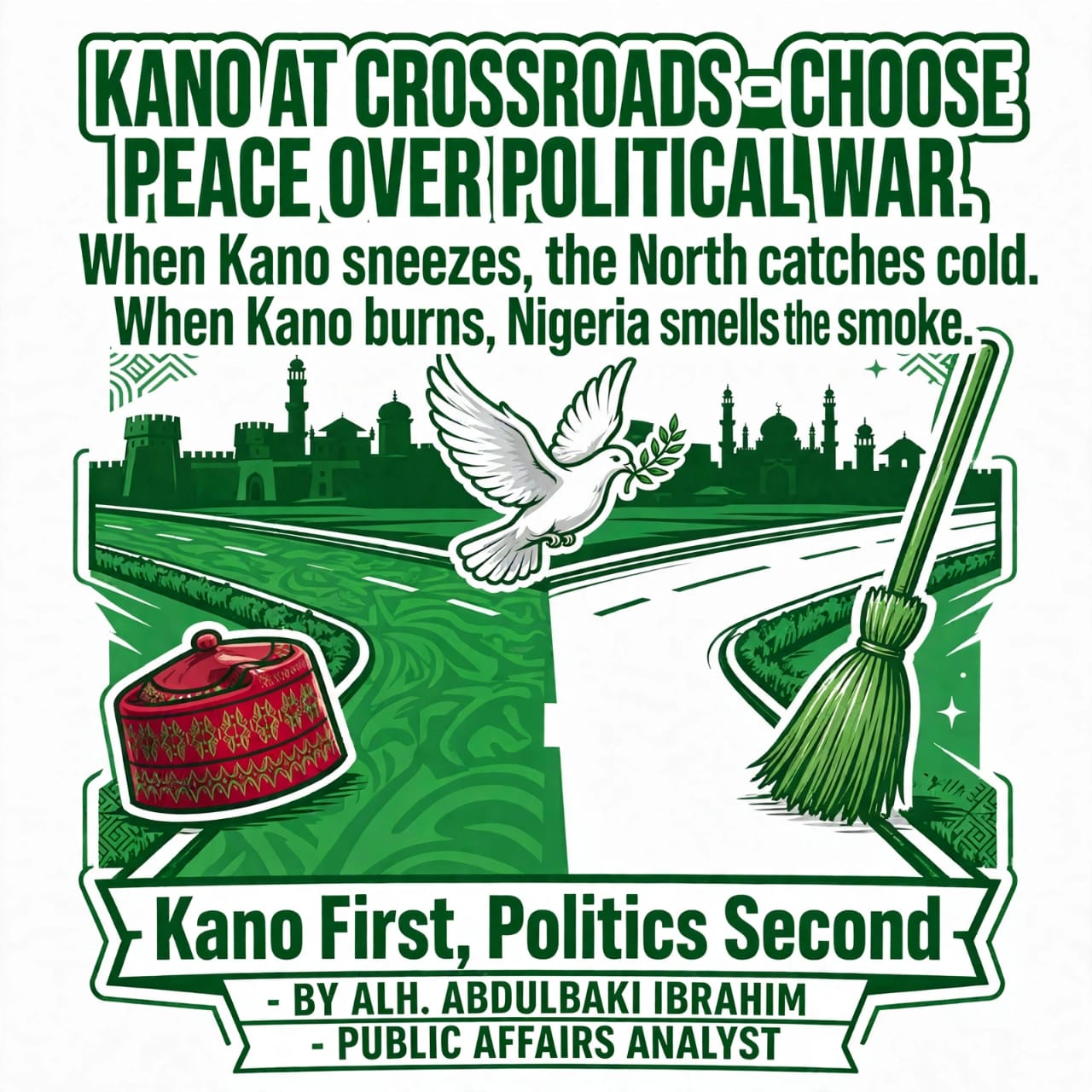
Kano is not just a state. Kano is a statement. When Kano sneezes, the North catches cold. When Kano burns, Nigeria smells the smoke. And right now, Kano is standing at a crossroads with two signposts: one says PEACE, the other says POLITICAL WAR.
The ancient city, the commercial and political heartbeat of Northern Nigeria, is once again at a delicate crossroads. Less than four years after a historic governorship contest that united and divided families, the political map of the state has changed beyond recognition.
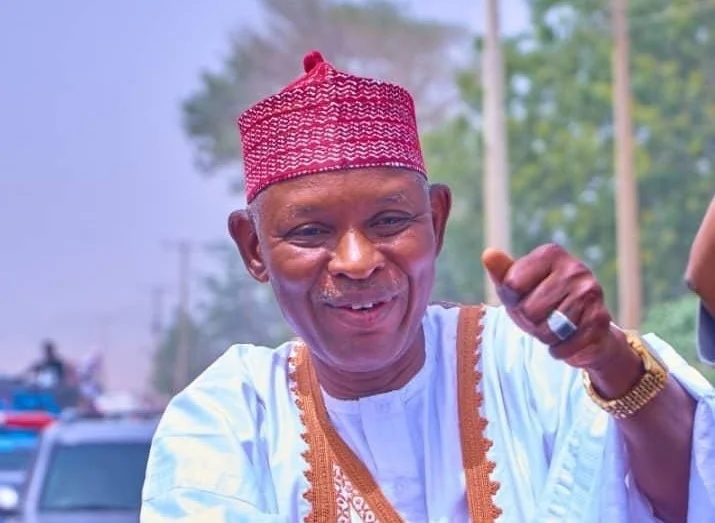
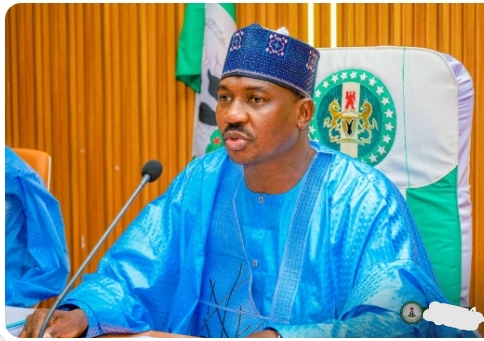
In 2023, Governor Abba Kabir Yusuf won the governorship on the platform of the New Nigeria Peoples Party (NNPP) with the full weight of the Kwankwasiyya movement led by Senator Rabiu Musa Kwankwaso.
Today, in 2026, the Governor sits as a member of the All Progressives Congress (APC), holding card number 001 of the party in Kano, while his former political godfather, Senator Kwankwaso, has emerged as the Vice-Presidential candidate of the National Democratic Congress (NDC), sponsoring Comrade Aminu Abdussalam Gwarzo as the NDC governorship candidate in Kano.
That is not a defection. That is an earthquake.
THE MISSING NAME THAT SHOOK KANO
The name of Comrade Gwarzo has been missing from the final list of governorship candidates published by the Independent National Electoral Commission (INEC).
In Kano, a missing name is not a clerical error. It is a political bomb.
INEC, relying on the Supreme Court judgment of September 24, 2026 in INEC vs Zenith Labour Party (SC/CV/495/2026), which restored Sections 77(5)-(7) and 84(2) of the Electoral Act 2026, has omitted candidates whose parties allegedly failed to submit a compliant membership register before conducting primaries.
This has affected not only Kano NDC, but also PDP candidates in Gombe and Ogun, and several others in Bauchi.
In other words: Kano is not alone in the storm. But Kano is the loudest thunder.
The question many are asking is: who has the upper hand?
Let us answer it without fear, without favour, and without Facebook noise.
THE PRESENT BALANCE OF POWER: STRUCTURE VS SENTIMENT
Truth must be told. As of today, two forms of power exist in Kano.
The first is structural power. It is held by Governor Yusuf and the new APC coalition.
He controls the machinery of government, enjoys the support of 22 members of the State Assembly, nine members of the House of Representatives from Kano, and 44 local government chairmen who defected with him in January. The reconciliation of January 26, sealed finally on October 8 between former National Chairman Dr. Abdullahi Umar Ganduje and Deputy Senate President Senator Barau Jibrin under President Bola Tinubu’s guidance, has given him federal cover and an automatic ticket.
In conventional politics, this is the upper hand. This is power you can touch. Power you can count. Power that signs files.
The second is emotional and movement power. It is held by Senator Kwankwaso.
The red cap. The Kwankwasiyya ideology. The language of the talakawa. It remains deeply embedded in the streets of Kano. Even after losing Government House, the loyalty remains.
I have seen it with my own eyes: a man in Kwari Market who has no job, no appointment, no contract, but will defend the red cap with his last breath. That is not politics. That is identity.
However – and this is the biting truth both camps must swallow – loyalty without a legally valid candidate on the ballot, as the INEC omission has shown, cannot win an election.
Sentiment cannot vote. Only a name on the ballot can vote.
Thus, APC has the upper hand in structure, NDC/Kwankwasiyya retains influence in sentiment.
THE ANECDOTE THAT EXPLAINS KANO BETTER THAN ANY POLL
Last week, I stood in Kwari Market, Kano. An old man selling caps – red caps and green caps side by side – looked at me and said:
“Alhaji, before, I knew which cap to sell. Now, I sell both. Because I don’t know which cap my customer will wear tomorrow.”
That old man is wiser than many analysts on television.
He understands what Abuja does not understand: In the North West, the voter is no longer following a party. The voter is following survival. Water. Jobs. Security. Respect.
Sell him sentiment, he will smile. Sell him solution, he will vote.
That is the election Kano wants. Not a war of insults. A war of ideas.
THE CLOCK HAS MOVED: FROM OCTOBER WINDOW TO NOVEMBER COURTS
Let me be honest and current, because a writer who lives in October while writing in November will look foolish.
The October 24 window provided by INEC under Section 32(2) of the Electoral Act has now passed. We are in November. The time for filing papers in secret is over. The time for courts, for INEC clarification, and for political settlement is now.
The battle for Gwarzo’s name is no longer at the INEC desk alone. It is now before the courts and before the conscience of the elders.
If the legal hurdle is not resolved through the courts and through lawful engagement, structure will defeat sentiment on February 6, 2027. Not because sentiment is weak, but because sentiment without a ballot is noise.
And let me ask both camps the biting question:
Can structure vote? No. People vote.
Can sentiment vote? No. Only a name on the ballot can vote.
Structure without street is empty. Sentiment without ballot is noise. Kano needs both.
HOW TO CONTAIN IT: MY THREE-PILLAR PROPOSAL
Having served this country for many years in various capacities, I have seen governments come and go, but Kano remains.
I am partisan to none but peace.
I therefore propose three pillars. Not for applause. For survival.
First, De-escalate Personalities.
The fight is no longer about ideology, it is about personalities.
Listen to the irony: The Governor himself warned against attacks on Kwankwaso, Ganduje and Barau, and Kwankwaso has told BBC Hausa that he is open to reconciliation, saying “I still like him.”
If the two gladiators are saying “I still like him,” why are their foot soldiers shouting “We will kill him”?
We should hold him to that word.
The social media armies of both sides must be called to order. In Kano, a Facebook post can become a street fight in 30 minutes. A TikTok insult can become a burnt shop by nightfall. We have seen it before. We must not see it again.
I propose a private Majalisar Dattawa – a council of 5-7 neutral elders and respected traditional title holders – to meet separately with both leaders and agree on rules of engagement: no incitement, no destruction of legacies, no importation of thugs.
Let elders do what elders are meant to do: whisper wisdom where youths are shouting war.
Second, Return to Legality, Not Emotion.
The Supreme Court has spoken. Section 77 of the Electoral Act must be obeyed by all parties, not selectively.
Emotion is sweet. Law is bitter. But only law can save us.
NDC must pursue its remedy now through the courts with affidavit and proof that Gwarzo and his deputy were in the register.
APC must also audit its own register. Because he who comes to equity must come with clean hands. If APC points one finger at NDC’s register, three fingers are pointing back at its own register.
We must support INEC to apply the law equally. When law takes centre stage, rumour dies.
Let me be blunt: Kano does not need a governor imposed by technicality. Kano does not need a governor imposed by sentiment. Kano needs a governor imposed by the people’s vote, under the law.
Anything less is a time bomb.
Third, Refocus Competition to Governance.
The people of Kano do not want insults, they want water, jobs, security, and respect for their traditional institutions.
Let government show its scorecard.
Let opposition show its alternative blueprint.
Let the debate be about the economy of Dawanau and Kwari markets, the education of our youth, and security along our borders, not about who abused who on Facebook.
Ask the market woman: Does your tomato seller care whether the governor wears red cap or broom? No. She cares whether she can carry her tomatoes from Dawanau to Sabon Gari without paying five illegal tolls.
Ask the graduate: Does he care about godfatherism? No. He cares about a job, a skill, a future.
That is the election Kano wants.
THE ANECDOTE KANO MUST NOT FORGET
An old Kano elder once told me: “In Kano, we quarrel in the morning, we eat together in the evening.”
That was Kano. That is the Kano we must protect.
I remember the Kwankwaso-Ganduje rivalry. Brothers became enemies. Supporters became warriors. Yet Kano survived.
I remember the Abacha era. Fear everywhere. Yet Kano survived.
I remember the Emirship tussles. Thrones shaken. Yet Kano survived.
We survived them because elders spoke up at the right time.
Now is that right time. Again.
CONCLUSION: KANO FIRST, POLITICS SECOND
Whoever wins on February 6, 2027, will still need a united Kano to govern. If we burn the house today because two brothers are quarrelling, we will have nowhere to sleep tomorrow.
Let me end with a punch that both camps must hear:
Structure without sentiment is a palace without people. Sentiment without structure is a crowd without a candidate. Kano needs both – power and people, law and love.
Choose peace. Choose law. Choose Kano.
Kano First, Politics Second.
Abdulbaki Ibrahim,
A Public Affairs Analyst, with years of institutional experience, writes from Kano, Nigeria.